The Bridge and the Shield: The Engineer’s Role in Client Communication
The Bridge and the Shield: The Engineer’s Role in Client Communication
In the software development lifecycle, the Project Manager (PM) is often referred to as the "bridge" between the technical team and the client. However, as I have grown in this industry, I have come to realize that this bridge occasionally requires technical pillars to prevent it from collapsing.
Many engineers view client meetings as a "waste of time." On the other hand, many PMs feel the need to bring an engineer to every single meeting just to feel secure. Both are extremes that should be avoided.
When is an Engineer’s Presence Required?
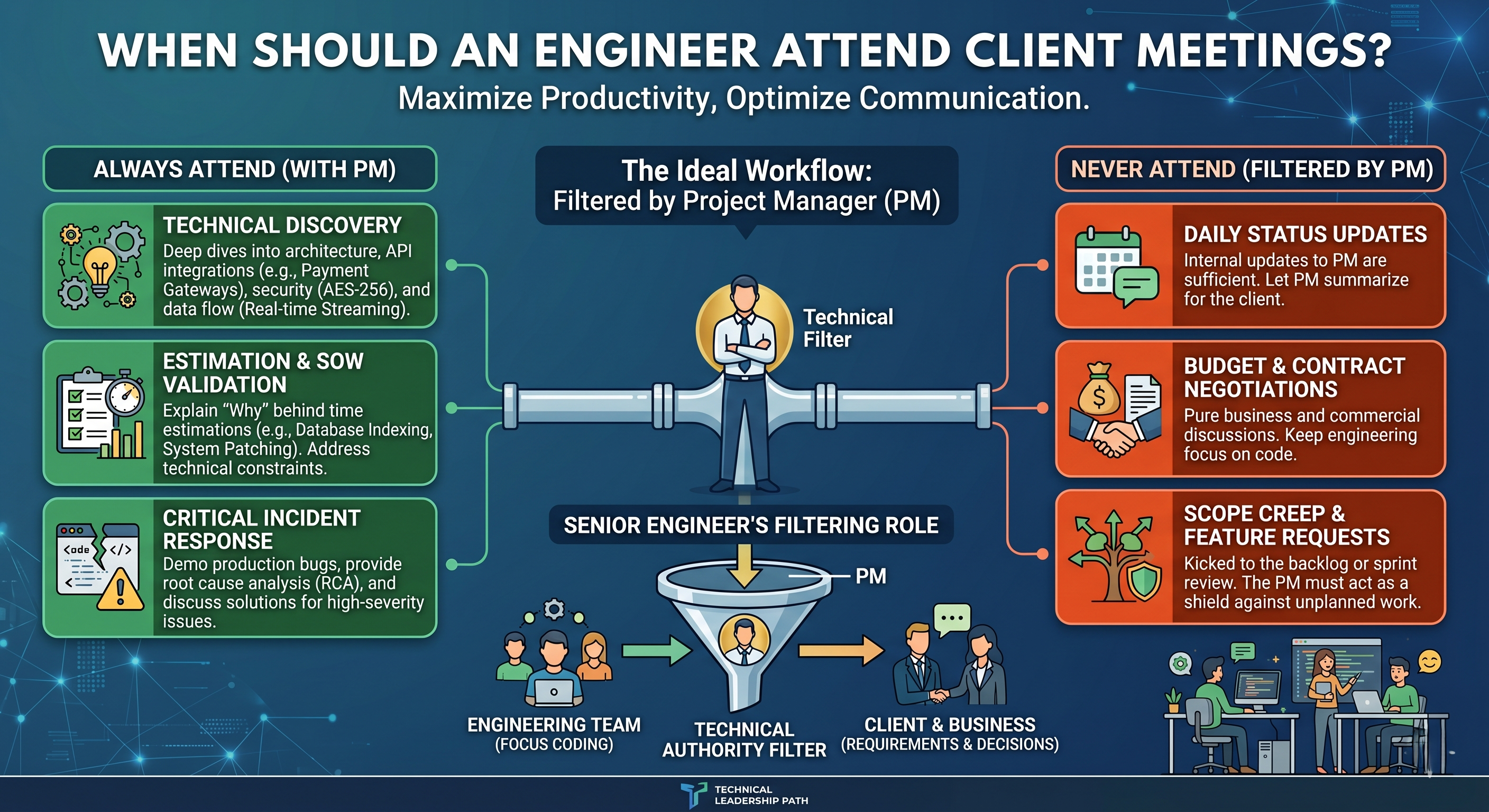
Based on my experience managing various projects, here is a matrix for engineer involvement:
1. Technical Discovery Phase (High-Level Design)
When a client requests a complex feature—such as a Payment Gateway integration requiring intricate encryption—the PM may understand the "what," but the Lead Engineer understands the "how" and its impact on the existing architecture. The engineer’s presence here is vital to prevent technical debt in the future.
2. Defending Estimates and the SOW
A Lead’s responsibility is to provide accurate task breakdowns and SOW (Statement of Work) estimations. If a client pushes for an unrealistic deadline, the engineer must be able to explain the technical risks—such as why code optimization cannot be deferred—using language the client can grasp.
3. Crisis and Incident Management
When a system faces critical failures, direct technical honesty from an engineer often builds client trust much faster than managerial diplomacy.
Protecting the Team’s Focus
As an Engineering Manager, your priority is to protect the team’s "deep work" or focus time. Junior engineers should rarely, if ever, face the client directly, allowing them to focus on building the system in a calm environment.
The Lead or Manager acts as a filter: we enter the meeting room to provide technical certainty and then return to the team to ensure execution aligns with the promises made.
Conclusion
The question is not "Should engineers attend client meetings?" but rather, "What technical information can only be conveyed by an engineer to ensure the project's success?" Use meeting time wisely, and let your PM handle the rest.